Living & Community March 16, 2026

Helpful Hacks to Make Spring Cleaning a Breeze

Spring is almost here, and with it comes that yearly urge to polish away the winter grime. Before you plunge into a multi-day cleaning spree, however, (or burn yourself out and put it off until next year) try these helpful tips. They just might win you a few hours back in your quest for clean…


1. Work Top to Bottom

Working from ceiling to walls to counters to floors guides dust and debris downwards and prevents any re-cleaning of the same areas. Here’s a room by room checklist so you don’t miss anything:

Click for a Room-By-Room Spring Cleaning Checklist PDF


2. Use the Dishwasher for More than Dishes

Disassemble dusty glass ceiling fixtures and light covers, then throw them in the dishwasher for a zero-effort sparkle. Ditto for children’s toys, glass candle holders, and microwave vent screens.


3. Dust Fan Blades with a Pillowcase

Make quick work of a gross fan blade by enclosing it in an old pillowcase which you hold shut as you pull it back off the blade. Step outside to shake out the dust bunnies, then repeat with the remaining blades.

Photo by Curtis Adams


4. Throw Draperies in the Dryer

For curtains that aren’t machine washable, you can still do a quick and easy refresh by putting them in the dryer for 15 minutes on no/low heat. Some dryers even have a steam setting to help gently reduce wrinkles and odors. Worried about dust mites? Either raise the dryer heat to high for fabrics that can take it, or bag up delicate curtains and freeze them for 24 hours.


5. Wash Windows When They’re Cool

Direct sunlight heats window glass, causing unsightly streaks to form before you have the chance to wipe them away. Wash them in the morning or on a cloudy day so that you only have to clean them once!

Photo by Liliana Drew


6. Let the Microwave Clean Itself

Add a few tablespoons of vinegar or some thin citrus slices to 2 cups of water. Microwave on high until it starts to boil, let sit for 5 minutes, then easily wipe clean with a paper towel or cloth.


7. Use Baking Soda on the Oven Door

Save a little elbow grease by mixing baking soda and water to form a thick paste, then spreading and letting it sit on the open oven door for 20 minutes. Gently wipe with a microfiber cloth, rinse and buff dry for a sparkling finish.


8. Shine Stainless Steel with Olive Oil

For an easy, chemical-free fix, put a little olive oil on a cloth and use it to polish away smudges and stains from your stainless-steel appliances/grill. You can find more ideas in this article on natural cleaning solutions.


9. Naturally Clean the Dishwasher

Clean any gunk out of the drain filter, then fill a dishwasher safe container with one to two cups of vinegar and place it in the top rack. Run a cycle without dishwasher detergent nor other dishes. Once the cycle is complete, sprinkle roughly a cup of baking soda along the bottom rack and run another cycle.


10. Put Garbage Disposal Gunk on Ice

Put a handful of ice cubes down the garbage disposal along with either 1 cup coarse salt or cut up lemon pieces with the peels on. Turn on the cold water and run the disposal until everything is ground up and cleared out. Continue running and flushing with cold water for another minute. Bonus: the ice will also scrape and sharpen the blades.


11. Machine Wash Shower Curtains

Did you know your shower curtain liner can be cleaned in the washing machine? The trick is to throw in a small bath towel with it to help scour away soap scum + that weird pink stuff. Add 1/2 cup vinegar during the rinse cycle (you can use the fabric softener dispenser) to reduce mold and mildew.


12. Bag Scum on Your Shower Head

Combine equal parts vinegar and water in a plastic bag. Tie it around your shower head so that it’s completely submerged, then soak for at least an hour. Blast the hot water to clear out any residue.


13. Use a Lint Roller on Fabric Surfaces

Great for dusting lampshades, fabric window shades, and speaker covers. It can also remove stubborn pet hair from upholstery.


14. Get the Funk Out

Deodorize carpets by sprinkling them with baking soda, working it in with a broom or soft brush, letting it sit for 30 minutes, and then vacuuming. You can use the same technique (minus the brushing) on funky mattresses.


15. Become a Robot Overlord

Once a novelty, robot vacuums have improved by leaps and bounds and are now a legitimate way to clean & mop your floors with minimal effort. Spring Cleaning may be the perfect time to invest in one and free up your time for more involved tasks.

Photo by Kindel Media


Need Some Motivation?

  • Offer to host an event in the near future so that you have a deadline to work toward.
  • Try organizer Shira Gill’s “15-minute win” by challenging yourself to tackle a single spring cleaning task each day…this can help you feel accomplished rather than overwhelmed, and those small tasks will add up to an extra-clean house before you know it.
  • Don’t forget the power of music! You’d be surprised how much your favorite upbeat tunes can lift your mood and keep you going.


Cleaning to Sell?

Here’s a printable checklist specifically for cleaning and preparing your home for market:

Home Prep Checklist PDF


Windermere Mercer Island


Find a Home | Sell Your Home | Property Research

Neighborhoods | Market Reports | Our Team

We earn the trust and loyalty of our brokers and clients by doing real estate exceptionally well. The leader in our market, we deliver client-focused service in an authentic, collaborative, and transparent manner and with the unmatched knowledge and expertise that comes from decades of experience.

2737 77th Ave SE, Mercer Island, WA 98040 | (206) 232-0446
mercerisland@windermere.com

© Copyright 2026, Windermere Real Estate/Mercer Island.

Living & Community August 30, 2019

Planning for the Life Expectancy of Your Home

Nothing in life lasts forever – and the same can be said for your home. From the roof to the furnace, every component of your home has a lifespan, so it’s a good idea to know approximately how many years of service you can expect from them. This information can help when buying or selling your home, budgeting for improvements, and deciding between repairing or replacing when problems arise.


According to a National Association of Home Builders (NAHB) study, the average life expectancy of some home components has decreased over the past few decades.  (This might explain why you’re on your third washing machine while Grandma still has the same indestructible model you remember from childhood.) But the good news is the lifespan of many other items has actually increased in recent years.


Here’s a look at the average life spans of some common home components (courtesy of NAHB).


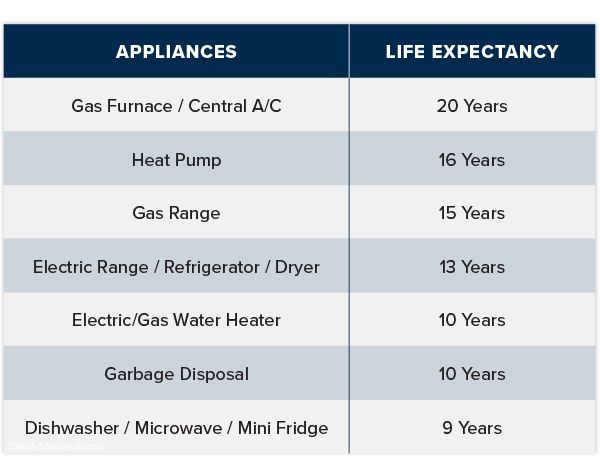
APPLIANCES. Of all home components, appliances have the widest variation in life spans. These are averages for all brands and models and may represent the point which replacing is more cost-effective than repairing. Among major appliances, gas ranges have the longest life expectancy, at about 15 years. Electric ranges, standard-size refrigerators, and clothes dryers last about 13 years, while garbage disposals grind away for about 10 years. Dishwashers, microwave ovens, and mini-refrigerators can all be expected to last about nine years. For furnaces, expect a lifespan of about 15 years for electric, 18 for gas, and 20 for oil-burning models. Central air-conditioning systems generally beat the heat for 10 to 15 years.


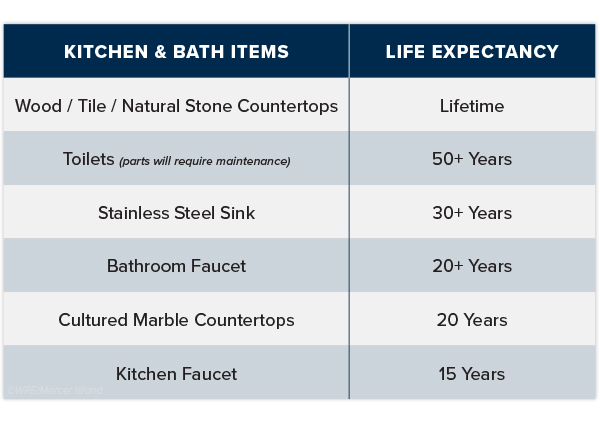
KITCHEN & BATH. Countertops of wood, tile, and natural stone will last a lifetime, while cultured marble will last about 20 years. The lifespan of laminate countertops depends greatly on the use and can be 20 years or longer. Kitchen faucets generally last about 15 years.  An enamel-coated steel sink will last five to 10 years; stainless will last at least 30 years; and slate, granite, soapstone, and copper should endure 100 years or longer. Toilets, on average, can serve at least 50 years (parts such as the wax ring, flush assembly, and seat will likely need replacing), and bathroom faucets tend to last about 20 years.


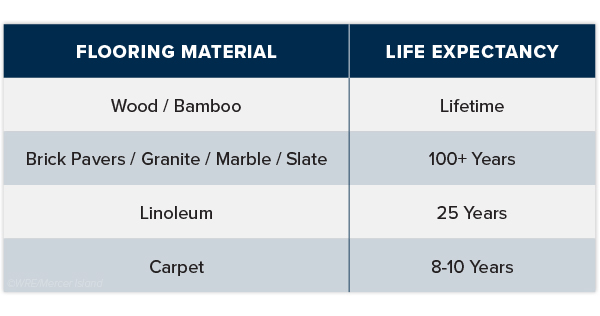
FLOORING. Natural flooring materials provide longevity as well as beauty: Wood, marble, slate, and granite should all last 100 years or longer, and tile, 74 to 100 years. Laminate products will survive 15 to 25 years, linoleum about 25 years, and vinyl should endure for about 50 years. Carpet will last eight to 10 years on average, depending on use and maintenance.


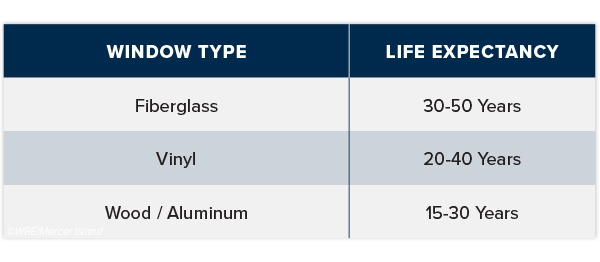
SIDING, ROOFING, WINDOWS & DECKS. Brick siding normally lasts 100 years or longer, aluminum siding about 80 years, and stucco about 25 years. The lifespan of wood siding varies dramatically – anywhere from 10 to 100 years – depending on the climate and level of maintenance. For roofs, slate or tile will last about 50 years, wood shingles can endure 25 to 30 years, the metal will last about 25 years, and asphalts got you covered for about 20 years. Unclad wood windows will last 30 years or longer, aluminum will last 15 to 20 years, and vinyl windows should keep their seals for 15 to 20 years. Cedar decks average 15-25 years if properly cleaned and treated, while high quality composite decks should easily last 30 years with minimal maintenance.


Of course, none of these averages matter if you have a roof that was improperly installed or a dishwasher that was a lemon right off the assembly line. In these cases, early replacement may be the best choice. Conversely, many household components will last longer than you need them to, as we often replace fully functional items for cosmetic reasons, out of a desire for more modern features, or as a part of a quest to be more energy efficient.


Are extended warranties warranted?

Extended warranties, also known as service contracts or service agreements, are sold for all types of household items, from appliances to electronics. They cover service calls and repairs for a specified time beyond the manufacturer’s standard warranty. Essentially, warranty providers (manufacturers, retailers, and outside companies) are betting that a product will be problem-free in the first years of operation, while the consumer who purchases a warranty is betting against reliability.


Warranty providers make a lot of money on extended warranties, and Consumers Union, which publishes Consumer Reports, advises against purchasing them.  You will have to consider whether the cost is worth it to you; for some, it brings a much-needed peace of mind when making such a large purchase. Also, consider if it the cost outweighs the value of the item; in some cases, it may be less expensive to just replace a broken appliance than pay for insurance or a warranty.


Find a Home | Sell Your Home | Property Research | Neighborhoods | Market Reports | Our Team

We earn the trust and loyalty of our brokers and clients by doing real estate exceptionally well. The leader in our market, we deliver client-focused service in an authentic, collaborative and transparent manner and with the unmatched knowledge and expertise that comes from decades of experience.

© Copyright 2019 Windermere Mercer Island.